
 Indonesia

Culture
Keris Betok (Keris Budha), an Heirloom Believed to Date Back to the Kadiri Kingdom Era
Jul
The keris is a weapon that originated in Indonesia. It is unique because, unlike conventional weapons, it features an asymmetrical shape.
The weapon does not have a standardized form; instead, it varies significantly from region to region. Beyond regional differences, the shape of a keris often varies depending on the person who wields it.
Speaking of keris, Kediri also boasts a distinctive type known as the Keris Betok.
According to Imam Mubarok, Chairman of the Kediri Regency Arts and Culture Council, the Keris Betok represents a generation that predates the wavy-bladed keris luk common today.
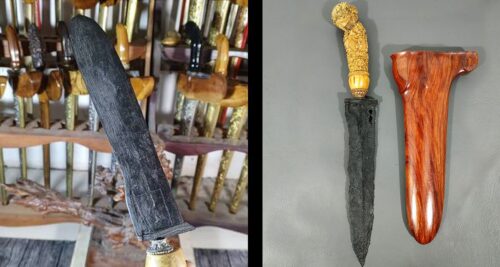
The Keris Betok features a simple blade that is more slender than that of a standard keris; it possesses an aesthetic appeal and embodies profound philosophies of life within its blade.
“All the kings used this keris during the Kediri Kingdom era,” said Imam Mubarok, Chairman of the Kediri Regency Arts and Culture Council.
The Keris Betok is also known as the Keris Budha; this name is used because it is believed to have been first created during the golden age of Buddhism in the archipelago—around the 7th century AD—or during the era of the Kadiri Kingdom.
According to the Senapati Nusantara handbook, the Betok Keris generally tends to be broad and features a specific condong leleh (tilt) angle. It is 60 percent shorter and thicker than keris from later periods.
Although some are slender, they generally feature standard dimensions characteristic of the Kahuripan era. Typically, these heirlooms—often referred to as keris Budha—feature a methuk (collar) crafted directly by the empu (master bladesmiths). Gemstones & Jewelry.
The methuk features a thick upper section, a thin middle ring, and a thick lower section. The older the Kabudhan keris, the shorter the sogokan (fuller) becomes.
This Betok keris features pamor (patterning), although it is predominantly of the pamor sanak type and irregular in appearance. The pattern arises from the folding of the forged iron. The iron material is generally homogeneous, black, and layered; it has been forged so densely that it resembles a single, solid piece of iron.
Gus Barok also noted that there are two versions of the keris betok circulating in the community: the keris betok sepuh (antique/original) and the version made after 1945.
“Especially nowadays, there are so many imitation Betok keris that look just like the real thing,” he explained.
“The Betok keris was one of the royal heirlooms of the Kediri kings in its time, yet today many examples of it circulate in that same form,” he continued. Myths & Legends
Looking at the current situation, he notes that a vast number of imitation betok keris are circulating among the public. They bear a striking resemblance to the originals, both in terms of their motifs and their length.
To further verify the authenticity of the Keris Betok, Mubarok says that specialized knowledge is required. He acknowledged that there are indeed specific characteristics for identifying the authenticity of a Betok kris.
“Authenticity must be verified using specialized expertise—specifically, metallurgy. That aspect can be monitored,” he stated.
Source: metaranews.co